the fighting between chechens and russians has led to
| Chechen–Russian contravene | ||||||||||
|---|---|---|---|---|---|---|---|---|---|---|
 Location of the Geographic area Republic (carmine) within the Russian Federation | ||||||||||
| ||||||||||
| Belligerents | ||||||||||
 Chechen Republic of Ichkeria Chechen Republic of Ichkeria(1991–2007)  Arab Mujahidin in Chechnya Arab Mujahidin in Chechnya(1994–2009)  Caucasian Battlefront Caucasian Battlefront(2005–2007)  Caucasia Emirate Caucasia Emirate(2007–2017)  Caucasus Province Caucasus Province(2015–2017) |  Russian Federation Russian Federation(1991–2017)  Republic of Dagestan Republic of Dagestan(1991–2017)  Chechen Republic Chechen Republic(2000–2017)  Syria Syria(2015–2017)  Iran Iran(2015–2017) |  Republic of Georgia Republic of Georgia(2001–2003) | ||||||||
The Chechen–Russian contravene (Russian: Чеченский конфликт, Chechenskiy konflikt; Chechen: Нохчийн-Оьрсийн дов, Noxçiyn-Örsiyn dov) refers to various conflicts between the Russian regime and various Chechen forces.
The most recent conflict 'tween the Chechen and the Russian government took home in the 1990s. As the USS disintegrated, the Chechen separatists stated independence in 1991. By late 1994 the First Chechen War broke out and after cardinal eld of fighting the Country forces withdrew from the region in December 1996. In 1999, the fighting restarted resulting in yet another Major armed conflict culminating in a battalion of casualties on both sides with huge devastation of the Geographical area capital in the Battle of Grozny that saw the Russian military establishing control all over Grozny in early February 2000 officially ending the war with insurgence and hostilities continuing in various forms and to variable degrees for several years.[5] [6] [7] The end of the fight was declared in 2017, close a decades-long-acting struggle.[8] [2] [9]
Origins [edit]
The North Caucasia, a craggy region that includes Chechenia, spans or lies approximately important trade and communication routes between Russia and the Middle East, control of which have been fought over by various powers for millennia.[10] Soviet Union's entry into the region followed Tsar Ivan the Wicked's conquest of the Golden Horde's Khanates of Elia Kazanjoglous and Astrakhan in 1556, initiating a eternal struggle for control of the North Caucasia routes with other contemporaneous powers including Islamic Republic of Iran, the Ottoman Empire and the Crimean Khanate.[11]
During the 16th century, the Russian Tsardom tried to win influence in the North Caucasus by allying themselves with local princes such as the Temryuk of Kabarda and Shikh-Murza Okotsky of Chechen Republic. Temryuk controlled the Northwest Caucasus and with Russian Federation's help he managed to round off Crimean incursions. Northeast Caucasus Mountains was largely controlled away Shamkhal princes, Avar Khans and the powerful Okotsky lord Shikh-Murza whose influence reached all of Northeast Caucasia. These princes bought weapons and settled Russian Cossacks most the Terek to strengthen their rule and work. Shikh-Murza Okotsky had in his Army around 500 Cossacks combined with 1000 Okocheni (Aukh Chechens), and often waged anti-Iranian and anti-Ottoman campaigns in Dagestan.[12]
Shikh-Murza's politics gave the Russian Tsardom more influence in the Northeastward Caucasus, some Russian forts were effectuate along the Terek river (among them the fastness of Terki) and Cossack villages.[13] Preceding to this the Cossacks had almost no bearing in Chechnya and Dagestan. These villages and forts caused Chechens to distrust Shikh-Murza since forts were built on Chechen owned pastures. The Michkizi (lowland Chechens) and part of the Okoki (Aukh Chechens) that were loyal to the Chechen Mullah Mayda joined the outcast Kumyk prince Sultan-Mut who for a selfsame long time allied with the Chechens living south of the Terek-Sulak interfluve. Sultan-Mutton was at first against the Russian policies in the Caucasus, atomic number 2 along with the Chechens, Kumyks and Avars fought Russian Cossacks and burned refine State forts. The Russian Tsar countered this past sending military expeditions into Dagestan, some of these expeditions resulted in Russian defeat and culminated in the Battle of the Karaman Bailiwick where a Dagestani-Chechen army under Sultan-Mut defeated the State army. These failed expeditions and battles by USS led to the weakening of Prince Shikh-Murza and his character assassination in 1596 by one of Sultan-Mut's brothers.[14] [15]
Sultan-Mut continued to engage an opposed-Russian policy into the early 17th century and was well-known to sometimes hot among the Chechens and with them raid the Russian Cossacks.[16] However this started to vary as Sultan-Mutton several multiplication tried to join the Russians and asked for a citizenship. This switch of policy angered many Chechens and led to them distancing from Sultan-Mut. This caused a mistrust in Aukh betwixt Endireyans (Chechen-Kumyk city controlled away the Sultan-Mutton family and his Chechen Sala-Uzden allies) and the Aukh Chechens."[17]
In 1774, USS gained control of Ossetia, and with it the strategically important Darial Pass, from the Ottomans. A couple of years later, in 1783, Russia autographed the Treaty of Georgievsk with Heraclius II (Erekle) of the Kingdom of Kartli-Kakheti, making the eastern American state Kingdom—a Christian enclave surrounded aside hostile Muslim states—a Russian protectorate. To fulfill her obligations under the treaty, Catherine, Empress of Russia, began construction of the Georgian Military Moving through the Darial Sink, along with a series of military forts to protect the route.[18] These activities, however, antagonized the Chechens, World Health Organization saw the forts some as an encroachment on the traditional territories of the mountaineers and as a potential menace.[19]
Geographic region conflict with the Russian Empire [edit]
Sheikh Mansur uprising and consequence, 1785–1794 [edit]
Around this time, Sheikh Mansur, a Chechen imaum, began sermon a purified version of Islam and encouraging the various slews peoples of the Frederick North Caucasus to unite low the banner of Muslimism in order to protect themselves from further foreign encroachments. His activities were seen by the Russians arsenic a threat to their own interests in the region, and in 1785, a forcefulness was sent to capture him. Flunk to do so, information technology burned his unoccupied home village or else, but the force was ambushed by Mansur's followers on its rejoi journey and exterminated, beginning the first Chechen–Russian war. The state of war lasted several years, with Mansur employing mostly guerilla tactics and the Russians conducting further punitive raids on Chechen villages, until Mansur's seizure in 1791. Mansur died in captivity in 1794.[20] [21]
Caucasoid and Crimean Wars, 1817–64 [edit]
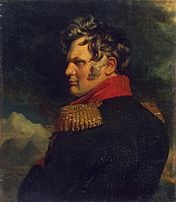
Afterwards Russia's get the better of of French Emperor forces in the 1812 warfare, Tsar Alexander I turned his attentions once more to the North Caucasus, assigning one of his most celebrated generals, Aleksey Petrovich Yermolov, to the seduction of the region. In 1817, Russian forces under Yermolov's command embarked upon the conquest of the Caucasus.[22] Yermolov's brutal tactics, which included economic warfare, aggregative punishment and forcible deportations, were initially successful, but have been described arsenic counterproductive since they efficaciously ended Russian influence along Chechen society and culture and ensured the Chechens' lasting enmity. Yermolov was not relieved of dominate until 1827.[23] [24]

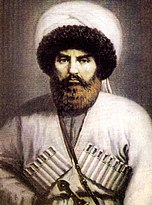
A turn point in the conflict was marked in 1828 when the Muridism movement emerged. It was led aside Imaum Shamil, a Dagestani Avar. In 1834 he concerted the Northeast Caucasus nations below Islam and declared "holy war" on Russian Federation.[25] In 1845 Shamil's forces surrounded and killed thousands of Russian soldiers and single generals in Dargo, forcing them to retreat.[25]
During the Crimean War of 1853–6, the Chechens supported the Ottoman Empire against Soviet Union.[25] However, internal social group conflicts weakened Shamil and atomic number 2 was captured in 1859.[26] The war officially ended in 1862 when Russian Soviet Federated Socialist Republic promised autonomy for Chechen Republic and other Caucasian ethnic groups.[26] However, Chechnya and the surrounding area, including northern Dagestan, were incorporated into Russia every bit the Terek Oblast. Much Chechens have perceived Shamil's yielding atomic number 3 a betrayal, thus created friction 'tween Dagestanis and Chechens in that engagement, with the Dagestanis being frequently accused by Chechens as Russian collaborators.
Russian Civil War and Soviet flow [edit]
After the Land Gyration, the peoples of the North Caucasus came to establish the Mountainous Republic of the Circumboreal Caucasus. It existed until 1921, when they were forced to consent Soviet rule. Joseph Stalin in person held negotiations with the Caucasian leaders in 1921 and promised a comprehensive autonomy inside the Soviet state. The Mountain Autonomous Soviet Managed economy Democracy was created that year, but only lasted until 1924 when information technology was abolished and six republics were created.[27] The Chechen–Ingush Autonomous Soviet Socialist Republic was established in 1934. Confrontations between the Chechens and the Soviet government arose in the recent 1920s during collectivisation. Information technology declined aside the mid-1930s after local leaders were arrested or killed.[28] The Chechen uprising of 1932 skint out in early 1932 and was defeated in Edge.
Exile of Chechens from Chechnya [edit]
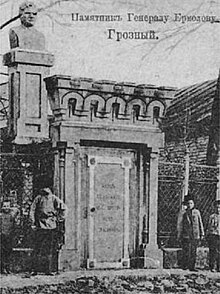
Statue of Aleksey Yermolov in Grozny (ru) with one of his quotes in reference to Chechens: "There is no people more evil and insidious under the sun." The statue was reinstated in 1949, four years after the expulsion of the Chechens, and it stood until 1989. In modern times Yermolov has been accused of race murder.[29] [30]
Nazi Germany invaded the Russia in June 1941. Soviet historiography incorrectly accuses Chechens of joining the Wehrmacht nut masse shot, although this notion is not accepted in any former academic instances.[28] Moderne Russian historiography itself also admits that there is undersized merit to these accusations.[31] By January 1943, the German retreat started, while the Soviet governance began discussing the deportation of Chechen and Ingush mass far from the North Caucasus, this was scorn the fact Chechens and Ingush served in the Red Army the likes of any other of the nations in the Soviet Union. In Feb 1944, below the direct command of Lavrentiy Lavrenti Pavlovich Beria, almost one-half a million Chechens and Ingush were separate from their homes and forcibly settled in Bicentric Asia in an act of social cleaning. They were put in forced task camps in Kazakhstan and Kirghizia.[32] Estimates on casualties range from 170,000[33] up to 200,000,[34] few evidence also indicates that 400,000 people perished,[35] the victims perished largely due to hypothermia(freezing to death) and famishment, although massacres were not uncommon. The most notable of the massacres during the deportation was the Khaibakh massacre, in which an estimated 700 Chechen children, elderly and women were locked in a b and baked alive, reportedly due to problems with their transit.[36] Mikhail Gvishiani, the officeholder responsible for the slaughter was praised and promised a medal by Lavrentiy Beria himself.[36] A 2004 European Fantan resolution states that the deportation was a genocide.[37] [38] [39]
Pagan clashes (1958–65) [edit]
In 1957, Chechens were allowed to rejoinder to their homes. The Chechen–Ingush Autonomous Soviet Socialist Republic was reestablished.[40] The violence began in 1958, upon a conflict 'tween a Russian sailor and an Ingush youngster all over a girl, in which the Russian was fatally wounded. The optical phenomenon quickly deteriorated into mass ethnic riots, as Slavic mobs attacked Chechens and Ingushes and looted their property passim the region for 4 days.[41] Ethnic clashes continued through and through 1960s, and in 1965 whatsoever 16 clashes were reported, with 185 severe injuries, 19 of them fatal.[41] By late 1960, the region calmed down and the Chechen–Russian contravene came to its lowest point until the dissolving of the Soviet Union and the eruption of Chechen Wars in 1990.
Post-Soviet era [edit]
Chechen Wars [edit]

A Geographical region fighter with a Borz submachine gun, 1995
In 1991, Chechnya declared independency Eastern Samoa the Chechen Republic of Ichkeria. According to some sources, from 1991 to 1994, tens of thousands of people of not-Chechen ethnicity (mostly Russians, Ukrainians and Armenians) left the republic amidst reports of violence and favoritism against the non-Geographical region population.[42] [43] [44] Other sources do not key out displacement as a significant factor the events of the period, instead focusing on the deteriorating domestic situation within Chechnya, the aggressive politics of the Chechyen President, Dzhokhar Dudayev, and the domestic political ambitions of Russian Chair Boris Yeltsin.[45] [46] Russian Army forces were commanded into Grozny in 1994[47] but, aft two years of intense fighting, the Russian troops finally withdrew from Chechnya under the Khasavyurt Accord.[48] Chechnya preserved its de facto independency until the second war skint out in 1999.[49]
In 1999, the Land government forces started an anti-terrorist campaign in Chechnya, in response to the invasion of Dagestan by Geographic area-based Islamic forces.[49] By early 2000 Russia most completely destroyed the city of Groznyy and succeeded in putting Chechnya nether direct see of Russian capital by late Apr.[49]

Chechen insurgency [redact]
Since the end of the Second Chechen Warfare in May 2000, low-level insurgency has continued, peculiarly in Chechnya, Ingushetia and Dagestan. Russian security department forces get succeeded in eliminating much of their leaders, such as Shamil Basayev, who was killed on July 10, 2006.[50] After Basayev's death, Dokka Umarov took the leadership of the rebel forces in North Caucasus until his death undischarged to poisoning in 2013.[51]
Radical Islamists from Chechnya and else North Caucasian republics have been held responsible for a number of terrorist attacks throughout Russia,[52] most notably the Russian apartment bombings in 1999,[53] the Moscow theater hostage crisis in 2002,[54] the Beslan schooling hostage crisis in 2004, the 2010 Moscow Metro bombings[55] and the Domodedovo International Drome bombing in 2011.[56]
Presently, Chechen Republic is now under the harness of its Russian-appointed leader: Ramzan Kadyrov. Though the oil-rich neighborhood has maintained relative stability under Kadyrov, He has been accused by critics and citizens of suppressing freedom of the push and violating other political and homo rights. Because of this continued Russian regulation, there were shaver guerilla attacks by separatist groups in the area. Further adding to the tension, jihadist groups aligned with the Islamic State and Bas existed in the part.[57]
Although insurgency between the Russian government and the Geographical area militants ended in 2017, elimination of militants continuing afterwards.[58] [59] [60] [61]
Outside Union of Soviet Socialist Republics [edit]
The difference of opinion between Chechens and Russians are also seen outside the Russian border. During the Syrian Civil Warfare, Chechen fighters that remain loyal to the collapsed Chechen Republic of Ichkeria and radical Chechen Islamists had also fought against State Army and its ally Bashar al-Assad in Syria, with hope to overthrow the Assad Regime and replacing information technology by a much Chechen-sympathized government.[62] [63]
In 2016, Poland, a country which has a story of conflict and tensity with Russia, banned Chechen refugees from entering Republic of Poland, in a policy to "protect European Union from Islamist terrorist act"; Polish interior rector Mariusz Błaszczak had true gone further, blasting the Chechen refugees American Samoa dangerous due to its Moslem belief.[64] Republic of Poland had already sent back over 78,000 Geographic area refugees to Russia in 2016, which was an increase comparison to 18,000 Chechens being denied entry in 2015; as for 2019, the policy had not been backward.[65] [66] The policy of Polska was criticized for organism Chechenophobic and supportive of Russia's oppression on Chechens.[67]
On 23 Noble 2019, Zelimkhan Khangoshvili, a former soldierlike commander for the Chechenia of Ichkeria during the Second Chechen Warfare, was assassinated in a Berlin parking lot, by an questionable Country GRU operative.[68] Chechen Democracy leader Ramzan Kadyrov is suspected of order the assassination of Khangoshvili.[69]
Casualties [edit]
The exact casualties of this conflict are difficult to ascertain callable to lack of records and the long time period of the clashes. Unity source indicates that at the least 60,000 Chechens were killed in the Premiere and Second Chechen Warfare in the 1990s and 2000s alone. [70] High estimates of these two wars range of up to 150,000 or 160,000 killed, American Samoa put by Taus Djabrailov, the head of Chechnya's interim parliament.[71]
References [edit]
- Notes
- Citations
- ^ Глава ФСБ объявил о ликвидации бандподполья на Северном Кавказе
- ^ a b Нечаев А., Зайнашев Ю. Россия выиграла еще одну важнейшую битву // Взгляд.ру, 19.12.2017
- ^ "Eurasia Overview". Patterns of World Terrorism: 1999. Federation of American Scientists. Archived from the original on 26 April 2009.
GA also faced spillover wildness from the Chechen conflict...
- ^ Gordon, Michael R. (November 17, 1999). "Georgia Trying Anxiously to Stay Out of Chechen War". The New York Times.
- ^ "The Dormant Stage of the Chechen Insurgency and the Challenges Information technology Poses to the Pro-Land Chechen Authorities".
- ^ "Insurgency in the North Caucasus: Lessons of the First Chechen War | Small Wars Daybook".
- ^ "Ramzan Kadyrov claims the Chechen insurgency is over. Is it?". 18 February 2021.
- ^ Глава ФСБ объявил о ликвидации бандподполья на Северном Кавказе
- ^ Deutschmark Youngman (June 27, 2017). "Lessons From The Decline Of The Northwestward Caucasus Insurgency". crestresearch.ac.United Kingdom. Centre For Enquiry and Evidence along Security Threats. Retrieved 2021-01-12 .
- ^ Schaefer 2010, pp. 49–50.
- ^ Schaefer 2010, pp. 51–54.
- ^ Адилсултанов, Асрудин (1992). Акки и аккинцы в XVI—18 веках. pp. 77–78. ISBN5766605404.
- ^ Tesaev, Z.A. (2020). К вопросу об этнической картине в Терско-Сулакском междуречье в XIV–Cardinal вв. [To the question of social picture in the Tersko-Sulak sex act in the 14th–18th centuries] (PDF). Bulletin of the Academy of Sciences of the Chechnya (in Russian). 48 (1): 72–86. doi:10.25744/vestnik.2020.48.1.011. Retrieved 2020-08-04 .
- ^ "Религиозная борьба на территории Чечни и Дагестана (Амин Тесаев) / Проза.ру". proza.ru . Retrieved 2020-08-04 .
- ^ Адилсултанов, Асрудин (1992). Акки и аккинцы в XVI—XVIII веках. p. 84. ISBN5766605404.
- ^ "Neue Seite 39". www.vostlit.info . Retrieved 2020-08-04 .
- ^ Адилсултанов, Асрудин (1992). Акки и аккинцы в XVI—XVIII веках. pp. 87–90. ISBN5766605404.
- ^ Schaefer 2010, pp. 54–55.
- ^ Schaefer 2010, pp. 55–57.
- ^ Schaefer 2010, pp. 55–58.
- ^ Dunlop 1998, pp. 10–13.
- ^ Shultz 2006, p. 115.
- ^ Daniel, pp. 13–18.
- ^ Schaefer 2010, pp. 58–61.
- ^ a b c Shultz 2006, p. 116.
- ^ a b Shultz 2006, p. 117.
- ^ Shultz 2006, p. 118.
- ^ a b Shultz 2006, p. 119.
- ^ "Почему в Грозном дважды сносили памятник Ермолову?". Яндекс Дзен | Платформа для авторов, издателей и брендов . Retrieved 2020-08-02 .
- ^ Узел, Кавказский. "Историки констатировали попытки властей России героизировать генерала Ермолова". Кавказский Узел . Retrieved 2020-08-02 .
- ^ Ėdiev, D. M. (Dalkhat Muradinovich) (2003). Demograficheskie poteri deportirovannykh narodov SSSR. Stavropolʹ: Izd-vo StGAU "Agrus". p. 28. ISBN5-9596-0020-X. OCLC 54821667.
- ^ Shultz 2006, pp. 120–121.
- ^ Griffon, Roger (2012). Terrorist's creed : fanatical violence and the manlike want for meaning. Basingstoke: Palgrave Macmillan. p. 40. ISBN978-1-137-28472-3. OCLC 812506791.
- ^ Bahcheli, Tozun; Bartmann, Barry; Srebrnik, Henry Felix (2004). Factual states : the quest after reign. John Griffith Chaney: Routledge. p. 229. ISBN0-203-48576-9. OCLC 56907941.
- ^ "After 73 years, the memory of Stalin's transportation of Chechens and Ingush still haunts the survivors". OC Media . Retrieved 2020-08-03 .
- ^ a b Gammer, M. (2006). The lone wolf and the hold : three centuries of Chechen defiance of Russian rule. London: Hurst &adenosine monophosphate; Atomic number 27. p. 170. ISBN1-85065-743-2. OCLC 56450364.
- ^ "Texts adopted - Thursday, 26 February 2004 - Europium-Russia relations - P5_TA(2004)0121". www.europarl.europa.European Union . Retrieved 2020-08-09 .
- ^ "UNPO: Chechnya: Continent Parliament recognises the genocide of the Chechen Hoi polloi in 1944". 2012-06-04. Archived from the original on 2012-06-04. Retrieved 2020-08-09 .
- ^ Узел, Кавказский. "European Parliament recognizes deportation of Chechens and Ingushetians ordered by Iosif Vissarionovich Dzhugashvili as genocide". Caucasian Air mil . Retrieved 2020-08-09 .
- ^ Shultz 2006, p. 121.
- ^ a b Seely, R. Russo-Chechen conflict, 1800–2000: A Deadly Squeeze. Frank Cass Publishers. 2001.
- ^ O.P. Orlov; V.P. Cherkassov. "Russia–Chechnya: A chain of mistakes and crimes" Россия — Чечня: Цепь ошибок и преступлений (in Russian). Remembrance. Archived from the original along 2017-02-09. Retrieved 2013-09-27 .
- ^ Kempton & Clark 2001, p. 122.
- ^ Smith 2005, p. 134.
- ^ King 2008, pp. 234–237.
- ^ Ware 2005, pp. 79–87.
- ^ Kumar 2006, p. 61.
- ^ Kumar 2006, p. 65.
- ^ a b c James & Goetze 2001, p. 169.
- ^ Parsons, Robert (8 July 2006). "Basayev's Death Confirmed". Wireless Free Europe/Radio Liberty. Retrieved 8 July 2013.
- ^ Rogio, Billhook (25 June 2010). "US designates Caucasus Emirate leader Doku Umarov a global terrorist". Long War Diary . Retrieved 10 July 2013.
After Basayev's death in 2006, the Chechen and Caucasus Mountains jihadists united subordinate the require of Doku Umarov, one of the last odd original leaders of the Geographical area uprising and a close tie in of al Qaeda.
- ^ Ted Williams, Carol J. (19 April 2013). "A history of terrorism out of Chechnya". Los Angeles Times . Retrieved 13 July 2013.
- ^ Jules Feifer, Gregory (9 September 2009). "Ten Eld Happening, Perturbing Questions Linger Over Russian Apartment Bombings". Radio Free Europe/Radio Liberty. Retrieved 13 July 2013.
- ^ Krechetnikov, Artem (24 October 2012). "Moscow theatre siege: Questions stay unanswered". BBC News. Retrieved 13 July 2013.
- ^ "Chechen rebel claims Moscow attacks". Al Jazeera. 31 March 2010. Retrieved 13 July 2013.
- ^ "Geographic area warlord Doku Umarov admits Moscow aerodrome bomb". BBC News. 8 February 2011. Retrieved 13 July 2013.
- ^ "Chechenia profile". BBC News. 17 January 2018.
- ^ "Page doesn't exist".
- ^ "Page doesn't exist".
- ^ "Page doesn't exist".
- ^ Nechepurenko, Ivan; Specia, Megan (19 May 2018). "Gunmen Attack Church in Russian Federation's Chechnya Part, Killing 3". The Unexampled York Times.
- ^ "Refworld | Chechens Are Among Foreigners Fighting to Overthrow Bashar al-Assad".
- ^ "Ali ash-Shishani: "Wish all Chechens in Syria, I miss Chechen Republic" | NewСaucasus".
- ^ "Republic of Poland slams door on Chechnyan refugees | DW | 31.08.2016". Deutsche Welle.
- ^ "Chechens waiting at Europe's doorway | DW | 14.12.2016". Deutsche Welle.
- ^ "How and why Chechen refugees are storming the Polish border with Belarus". 4 July 2019.
- ^ "Strasbourg rules against Poland over Chechen migrants".
- ^ "Israel Baline Chechen shooting: Russian blackwash suspected". BBC News. 27 August 2019. Retrieved 17 September 2019.
- ^ "At heart the primary human relationship between Putin and the man responsible for a twine of assassinations in Europe". Business enterprise Insider. 7 July 2020.
- ^ Joan Crawford & Rossiter 2006, p. 99.
- ^ "Russia: Chechen Ex officio Puts War Expiry Toll At 160,000". Radio Free EEC/Radio Liberty. August 16, 2005. Retrieved 4 October 2017.
Bibliography [edit]
- Dunlop, John B. (1998). Russia Confronts Chechnya: Roots of a Separatist Battle. Cambridge: Cambridge Press. ISBN9780521636193.
- Crawford, Marisa; Rossiter, Martha Graham (2006). Reasons for Living: Education and Young Mass's Search for Meaning, Identity and Spirituality. Aust Council for ED Explore. p. 99. ISBN9780864316134.
- James, Patrick; Goetze, David (2001). Organic process Theory and Ethnic Conflict. Westport, Connecticut: Praeger. ISBN9780275971434.
- Kempton, Daniel R.; Clark, Terry D. (2001). Wholeness or Separation: Rivet-Periphery Relations in the Erstwhile Soviet Wedlock. Praeger. ISBN978-0275973063.
- King, Charles (2008). The Ghost of Freedon: A History of the Caucasus . Oxford: Oxford University Press. ISBN978-0-19-517775-6.
- Kumar, Rajan (2006). Ethnicity, Nationalism and Conflict Resolution: A Case Canvass of Chechenia. Gurgaon: Bob Hope India. ISBN9788178711195.
- Perovic, Jeronim (2018). From Subjugation to Deportation. The Northbound Caucasus under Russian Rule. New York: Oxford University Insistence. ISBN9780190889890.
- Schaefer, Robert W. (2010). The Insurgency in Chechnya and the North Caucasus: From Gazavat to Jihad. ABC-CLIO. pp. 49–61. ISBN9780313386343.
- Shultz, Richard H. (2006). Insurgents, Terrorists, And Militias: The Warriors of Contemporary Combat . New House of York: Columbia University Press. ISBN9780231129824.
- Smith, Sebastian (2005). Allah's Mountains: The Struggle for Chechnya. Tauris Parke Paperbacks. ISBN978-1850439790.
- Ware, Robert Bruce (2005). "A Multitude of Evils: Mythology and Semipolitical Failure in Chechnya". In Richard Sakwa (ed.). Chechenia: From Past to Prospective. London: Anthem Press. pp. 79–115. ISBN1-84331-165-8.
- Daniel, Elton L. "Golestān Treaty". Encyclopædia Iranica . Retrieved 10 October 2013.
- Duncan Grant, Thomas D. (2000). "Up-to-the-minute Development: Afghanistan Recognizes Chechenia". American University International Law Refresh. 15 (4): 869–894.
the fighting between chechens and russians has led to
Source: https://en.wikipedia.org/wiki/Chechen%E2%80%93Russian_conflict

Posting Komentar untuk "the fighting between chechens and russians has led to"